
Asking questions
I learned Japanese for many years in my teens. And I certainly remember that the most common way to make a sentence into a question, or to recognize a question, was that it ends in “ka”. Mandarin has a similar word in
吗 (ma)
It’s often translated as a question mark. If you look carefully, you can see that the character has two characters (or radicals) within it. On the left is 口 (Kǒu) which means “mouth”. That provides part of the meaning. On the right is 马 (Mǎ) which means “horse”. It’s used to provide the sound, not the meaning.
Let’s see an example:
你有朋友。(Nǐ yǒu péngyǒu.)
That literally is “You have friend”, but more likely “You have friends”.
If we add the question mark:
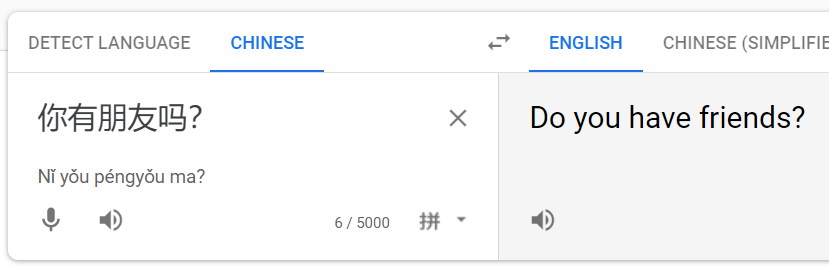
你有朋友吗?(Nǐ yǒu péngyǒu ma?)
And it becomes “Do you have friends?”
Note that even in English, we could use the sentence “You have friends”, as a question, just by changing the tone of how we say it.
2021-02-12